


.svg)


Low Income Energy Assistance Programs in California
California energy bills rank among the highest in the country, and for low-income households already stretched to the limit, one bad month can turn into a shutoff notice fast. The good news is that California has more low-income energy assistance options than most residents ever hear about, and knowing which program to pursue first can mean the difference between staying warm this winter and sitting in the dark. This article covers the major low-income energy assistance programs available in California for 2026: LIHEAP, CARE, FERA, utility emergency funds, and the lesser-known upgrade programs that actually reduce your bills for good, not just this month.
Synergy Companies has spent over a decade helping California homeowners navigate this system. We work across nearly every major utility territory in the state, and we've seen firsthand how many qualifying households never claim the benefits they're owed, simply because the process is complicated. This guide is designed to change that.
Low-income energy assistance in California: the main programs and what each one actually does
Before jumping into eligibility numbers, it helps to understand that these programs serve very different purposes. Some offer a one-time crisis payment to stop a shutoff. Others apply an ongoing discount to every bill you pay. And some fund actual home improvements that shrink your energy use permanently. Knowing which category matches your situation tells you where to start.
LIHEAP: the federal program for heating, cooling, and crisis bills
LIHEAP, the Low Income Home Energy Assistance Program, is federally funded and administered in California by the Department of Community Services and Development (CSD) through a network of local agencies. It covers three types of help: heating assistance ranging from $94 to $1,500, cooling assistance from $283 to $932, and crisis assistance up to $1,500 for households facing shutoff or unsafe heating and cooling conditions. This is a one-time benefit per program year, not a monthly discount, so it works best as a safety net rather than a long-term bill solution.
CARE: the monthly utility discount that lowers every bill
The California Alternate Rates for Energy program, known as CARE, delivers ongoing relief by applying a percentage discount to your monthly utility bill through PG&E, SCE, SoCalGas, SDG&E, and other California utilities. For 2026, CARE discounts on electricity run 30, 35%, with PG&E offering 35% or more, and natural gas discounts sit at 20% across major utilities. Unlike LIHEAP, CARE keeps working month after month as long as you remain eligible. Each utility enrolls customers directly, so the application goes through whoever sends your bill.
FERA: for households that earn just a bit too much for CARE
FERA, the Family Electric Rate Assistance program, is the bridge for households with three or more members whose income sits above the CARE ceiling but is still limited. FERA provides an 18% discount on electricity bills and is applied directly through the utility. If your household is too large for CARE but not high-income, FERA is likely your path. CARE and FERA are separate programs with different eligibility criteria; most households will qualify for one based on income and household size. Check with your utility to confirm which program fits your situation.
2026 eligibility rules: who qualifies and what the income limits look like
Both LIHEAP and CARE use gross monthly household income (before taxes) measured against federal poverty guidelines, though CARE income rules can vary somewhat by utility, check with your provider or the CPUC for utility-specific details. The limits below reflect where most California households fall, and they're higher than many people expect. If you've assumed you don't qualify without actually checking the numbers, this section is worth a careful read.
LIHEAP income limits for 2026 by household size
LIHEAP generally covers households at or below 200% of the federal poverty level. The table below shows the 2026 gross monthly income limits published by California CSD.
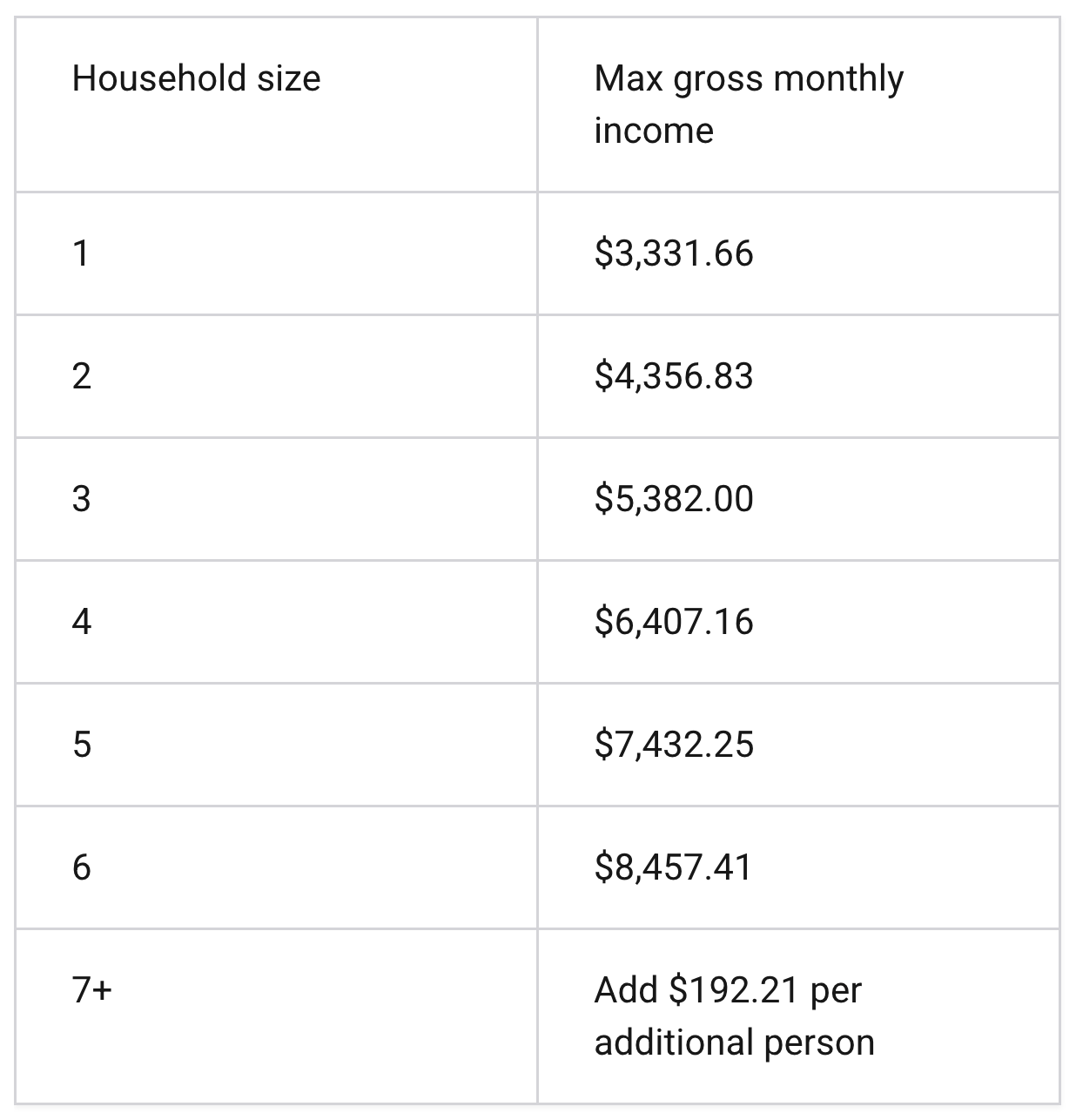
These are monthly figures, not annual. A family of four earning $76,000 per year may still qualify, since that works out to roughly $6,333 per month, which falls within the threshold. Run your own numbers before assuming you're over the limit.
CARE and FERA eligibility thresholds
CARE generally follows a 200% federal poverty level guideline for many households. Households already enrolled in means-tested programs like Medi-Cal, CalFresh, SSI, or SSP often qualify automatically without submitting separate income documentation, check CPUC guidance or your utility's CARE enrollment page for details on streamlined enrollment.
FERA covers households of three or more members at roughly 200, 250% of the federal poverty level, with a 2026 annual income ceiling of approximately $54,100 for smaller qualifying households, rising by family size. Seniors, people with disabilities, and customers on medical baseline rates may face an easier enrollment path than the standard income review. If you're uncertain whether you fall under CARE or FERA guidelines, start with CARE and your utility will guide you from there.
How to apply for low-income energy assistance in California
These programs are administered through three separate systems: local county agencies for LIHEAP and weatherization, utility companies for CARE and FERA, and some online portals that can speed up the process. Knowing which door to knock on first saves a lot of back-and-forth.
The documents you need before you apply
Walking into a LIHEAP appointment or starting an online application without the right paperwork is one of the most common reasons applications get delayed or denied. Gathering everything in advance turns a multi-week process into a much faster one. Requirements are consistent across most programs, with only minor variations by agency or utility.
Every program requires a government-issued photo ID for the applicant. You'll also need Social Security numbers for all household members, and most agencies ask for the actual Social Security card for the primary applicant. Proof of income is required for all adults 18 and older, covering the last 30 days. Acceptable documents include recent pay stubs, benefit award letters from Social Security, SSI, or unemployment insurance, and a zero-income certification form if someone in the household has no current income.
Most agencies require your complete current utility bill, including all pages, showing the account holder's name, service address, meter readings, and at least 22 service days. A bill that only shows a summary page is often not enough. For housing, bring a lease agreement, mortgage statement, rent receipt, or a signed landlord letter if utilities are included in your rent. If you have a shutoff notice, bring that too. A shutoff notice can trigger faster crisis-level processing and should always be disclosed at the start of the application.
Applying for LIHEAP through your county agency
California uses roughly 41 local service providers to administer LIHEAP, and the right agency depends entirely on your county or ZIP code. The fastest way to find your local provider is through the CSD "Find Services in Your Area" tool on the CSD website. If you're unsure where to start, call the statewide CSD hotline at 1-866-675-6623 , which handles general LIHEAP inquiries and can point you to the correct local office. Some counties use their own application portals, Orange County, for example, uses caliheapapply.com, while others require an in-person appointment or a paper submission. Once you've located your agency, schedule an appointment, confirm the current document checklist with that specific agency, and bring everything on the list to avoid delays.
Enrolling in CARE or FERA through your utility
CARE and FERA are applied for directly through your utility provider, not through a county agency. PG&E, SCE, SoCalGas, SDG&E, LADWP, and other California utilities all allow residents to apply online through their account portal, by phone, or by mailing a paper application. The process follows three steps: check eligibility on your utility's website using their income screening tool, gather your income documentation, and submit the application. If you're already enrolled in Medi-Cal or CalFresh, the process is even simpler, provide proof of that enrollment and the utility will process your CARE application without a separate income review.
Facing disconnection: how crisis assistance works and what to do right now
If you're already holding a shutoff notice, the standard 6-to-60-day processing timeline for LIHEAP doesn't apply to you. California's crisis LIHEAP is designed specifically for households facing imminent disconnection, and it moves fast, typically within 48 hours of a completed crisis application, per California CSD crisis-processing policy. Act immediately, because every day matters when a shutoff date is approaching.
What triggers expedited LIHEAP crisis processing
A shutoff notice, an active disconnection, or a broken heating or cooling system during extreme weather can all qualify a household for expedited crisis review. Crisis benefit amounts can reach up to $1,500 and are paid directly to the utility, not to the household. Standard LIHEAP benefits take weeks to process; crisis processing takes 48 hours or less when the conditions are met and the application is complete. That's why bringing your shutoff notice to the agency from the very first contact makes such a difference.
Immediate steps and who to call
If you have a shutoff notice in hand right now, follow this sequence. First, call your local LIHEAP agency immediately and clearly state that you have a shutoff notice. That single statement flags your case for crisis screening. Second, call your utility directly and ask about their own emergency fund: PG&E's REACH program offers credits up to $800, SCE has the Energy Assistance Fund, and SDG&E offers the Neighbor to Neighbor program with no income requirement. Third, ask your utility for a 48-hour payment hold while your LIHEAP crisis application is being processed. Many utilities will grant a brief hold if you can show you have an active assistance application in progress. If you don't know which agency to call first, dial 1-866-675-6623 and CSD will direct you to the right local provider.
Beyond bill discounts: no-cost home upgrades that cut energy use for good
Bill discounts and crisis payments help you get through a hard month. Home upgrades change the equation permanently. Households that qualify for LIHEAP and CARE often qualify for deeper programs that replace failing equipment and seal leaky homes, reducing energy consumption every single month going forward rather than just offsetting one bill.
Weatherization and utility-funded upgrade programs
The federal Weatherization Assistance Program (WAP) and utility-funded programs through PG&E, SCE, SoCalGas, and SDG&E deliver a range of free improvements to qualifying low-income households, including:
- Insulation and air sealing
- HVAC repair or replacement
- Duct sealing
- LED lighting upgrades
- Smart thermostats
Income eligibility for most of these programs mirrors the LIHEAP and CARE thresholds, so if you've already applied for one, you're likely in range for the other. The difference in impact is significant: a one-time LIHEAP payment might cover a past-due bill, but weatherization improvements and a properly functioning HVAC system can meaningfully reduce monthly energy costs year after year, with typical savings varying by household and the specific measures installed.
How Synergy Companies helps residents go further
Navigating California's energy assistance programs across multiple utilities, dozens of local agencies, and overlapping program rules is genuinely confusing, even for people who work in the field. Synergy Companies was built to do that navigation work on behalf of homeowners. As a California energy efficiency contractor with relationships across PG&E, SCE, SoCalGas, SDG&E, IID, Riverside Public Utilities, and other utility territories, Synergy identifies which no-cost upgrade programs your household qualifies for, handles the paperwork, and manages the installation from start to finish, as a company-provided service at no cost to you.
For residents who have already signed up for CARE or received a LIHEAP payment, working with Synergy is the next logical step. Getting the monthly discount is good. Fixing the home so it doesn't need as much energy in the first place is better. Synergy's team has worked with California households across the state to help them access programs they didn't know existed, and the results go beyond lower bills: they're more comfortable homes that stay warmer in winter and cooler in summer without running equipment as hard.
Your action plan for low-income energy assistance in California
California has real money set aside for households struggling with energy costs, but that money flows through federal, state, and utility systems that most people only partially understand. The programs are real, the benefits are meaningful, and the eligibility thresholds are higher than most people expect. The obstacle isn't qualification, it's knowing where to apply and showing up with the right paperwork.
If you need low-income energy assistance in California, here's where to start: apply for LIHEAP first if you're facing a shutoff or a crisis. Enroll in CARE or FERA through your utility for ongoing monthly savings. Then explore no-cost home upgrade programs to address the root cause of high bills, not just the symptoms. Use the CSD agency locator on their website and call 1-866-675-6623 as your first two moves if you're unsure where to begin.
When you're ready to find out which no-cost upgrade programs your home qualifies for, get in touch with the team at Synergy Companies. We'll do a free assessment, match your household to the right programs, and handle the process from eligibility check to completed installation. One conversation could mean a more comfortable home and a smaller bill every month from here on out.


