


.svg)


Furnace Installation: Costs, Timeline, and Hiring a Pro
When you need a furnace installation and a contractor hands you a quote that means nothing, you're suddenly being asked to sign before you've had a chance to think. That's a stressful position, one that leads a lot of homeowners into overpaying, under-buying, or skipping steps they'll regret later. You deserve straight answers before any paperwork changes hands.
At Synergy Companies, we've walked thousands of California homeowners through furnace replacements from the first call to the final inspection. What follows is the same honest framework we share with every customer: what it actually costs, what drives that number up or down, how the process unfolds, and one option many California homeowners don't realize is available to them.
What furnace installation actually costs in 2026
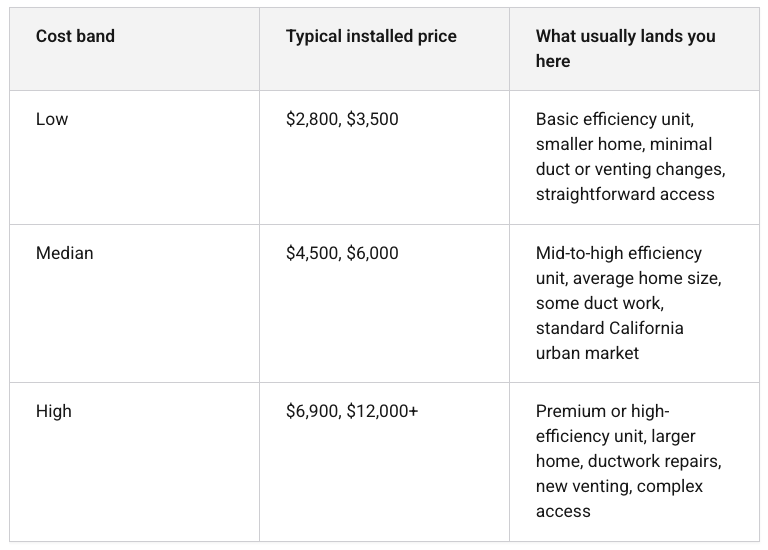
Low, median, and high installed price ranges
Most homeowners pay between $2,800 and $6,900 for a complete gas furnace installation in 2026, with a realistic average near $4,800. That figure covers equipment, labor, permits, and standard startup. Premium systems, larger homes, or projects with significant ductwork or venting changes can push the total to $12,000 or more. For a third-party cost reference, consult a new furnace cost guide.
The cost drivers that push your project up or down
Four factors move the number more than anything else: fuel type, efficiency rating, home square footage, and ductwork condition. Gas furnaces dominate most California installations, but the efficiency tier you choose, measured in AFUE, can swing the equipment cost by $1,000 or more on its own. A home with deteriorating ducts needs repairs before a new furnace can perform correctly, which adds to the total before a single component is touched.
Labor and regional pricing compound everything. California's urban markets, from the Bay Area to San Diego, run consistently above the national average because of higher labor costs and more demanding permitting requirements. Build that reality into any budget you put together.
Add-on costs most quotes don't mention upfront
The initial quote often covers the unit and basic installation. What shows up later, once the crew is on site, is where budgets get derailed. The most common line items that appear after the initial estimate include:
- Ductwork repairs or modifications: $300, $3,000+
- Venting or flue work: $300, $1,500
- Electrical upgrades or dedicated circuits: $200, $1,500
- Condensate drain installation: $100, $500
- Permits and inspections: $75, $800 depending on jurisdiction
Homeowners who budget only for equipment almost always face surprises once installation starts. Build in a 15-20% contingency buffer on top of any quote, and ask any contractor to walk through what's included and what could be added before you agree to anything.
Furnace types, efficiency ratings, and sizing
Gas vs. electric: which one belongs in your home
Gas furnaces dominate California homes because they heat fast and cost less to operate in regions with cold winters. Electric furnaces carry lower upfront price tags but typically run higher monthly operating costs in California's colder inland and mountain climates. Propane and dual-fuel setups exist as niche solutions for areas without natural gas service, but they apply to a small slice of California homes.
California has climate-zone-specific efficiency requirements under Title 24. The baseline AFUE minimum in most zones is 80%, and choosing a system that doesn't meet local code can complicate the installation, delay inspection, and disqualify you from utility rebates or no-cost programs. A contractor who knows California's requirements will steer you toward a compliant system from the start.
Understanding AFUE and why it changes your long-term bill
AFUE stands for Annual Fuel Utilization Efficiency. It measures what percentage of each fuel dollar actually heats your home. A furnace rated at 95% AFUE converts 95 cents of every dollar burned into useful heat and wastes only 5 cents. Standard units start around 80% AFUE; high-efficiency models run from 90% to 98%.
Higher AFUE means a higher purchase price but lower monthly bills. For California homeowners on PG&E or SoCalGas, the operating cost difference between an 80% and a 96% AFUE unit adds up to real money over a 10-15 year lifespan. The right efficiency tier depends on how long you plan to stay in the home and what the utility cost difference looks like in your service area.
Why sizing matters more than brand
An undersized furnace runs constantly and still can't keep up on the coldest days. An oversized unit short-cycles, meaning it fires, reaches the setpoint temperature quickly, and shuts off before completing a full heating cycle. Short-cycling wears out components faster and often leaves rooms at uneven temperatures.
Proper sizing requires a Manual J load calculation, which accounts for insulation levels, window area, ceiling height, and local climate data. It's not a rough square-footage estimate, and it's not something an online calculator handles reliably. This is one of the clearest reasons to work with a trained HVAC professional rather than trying to size a system yourself.
The installation timeline: from first call to final startup
Furnace installation day: what happens
A straightforward furnace swap in an accessible location typically takes 4-8 hours from the crew's arrival to startup. Same-day completion is realistic when the unit is in stock, the install location doesn't change, and no major duct or venting modifications are needed. For a detailed timeline and what crews typically do on install day, see a how long to install a furnace guide.
The sequence runs in this order:
- Old unit disconnect and removal
- New unit placement and securing
- Gas and electrical connections
- Venting hookup
- Duct reconnection
- System startupFinal testing with you present to confirm operation
That final walkthrough matters. A thorough installer won't hand you the paperwork and leave. They'll show you how the system operates, confirm the thermostat is communicating correctly, and verify airflow through the home before closing out the job.
Factors that stretch the timeline
Ductwork modifications can add 1-4 hours to an otherwise straightforward job. New gas line routing or electrical panel work can add another 1-2 hours, or it may require a second crew visit. Tight or hard-to-reach spaces, including attics, crawl spaces, and mechanical closets, slow every phase of the job and make even simple tasks take longer than expected.
Special-order equipment or custom venting can push the overall project to 2-3 days, especially when parts aren't in a local distributor's stock. Ask any contractor upfront whether the unit you're purchasing is available immediately or on order. That single question can be the difference between a one-day job and a week-long wait in a cold house.
Permits and inspections you can't skip
Most California jurisdictions require a mechanical or HVAC permit before a furnace installation begins, and an electrical permit if wiring is involved. Inspectors check venting, gas connections, clearances, combustion air, and electrical tie-ins. Skipping permits isn't a shortcut; it's a liability. Unpermitted work can trigger fines, require the homeowner to fund a complete re-installation, and create complications during a home sale.
A qualified HVAC contractor pulls the permits for you and schedules the inspection. That's standard practice, not an optional service. If a contractor suggests skipping permits to save money or time, that's a clear reason to keep looking.
Why hiring a licensed HVAC pro is non-negotiable
The real risks of DIY furnace installation
Gas leaks, carbon monoxide exposure, electrical faults, and fire are the primary dangers of improper furnace installation. These aren't edge cases; they're the most common outcomes when combustion systems are connected incorrectly. Mistakes in gas or venting connections often aren't visible or detectable without proper testing equipment, which means a dangerous situation can exist for weeks before anything obvious happens.
Beyond the safety risks, most manufacturers require installation by a licensed technician to honor the equipment warranty. A DIY install can void the warranty entirely on a brand-new system, leaving you responsible for the full cost of any repair or replacement that follows. That defeats the entire purpose of buying a new unit.
What credentials and questions actually matter
In California, furnace installation work falls under the C-20 license classification from the Contractors State License Board: Warm-Air Heating, Ventilating and Air-Conditioning Contractor. Any contractor you hire should hold this license and be able to pull permits in your specific jurisdiction. NATE certification is a voluntary credential that indicates technical training, but it doesn't replace a contractor's license.
Ask any installer four questions before agreeing to work:
- Are you licensed and insured in California?
- Will you pull the permit?
- Do you perform a Manual J load calculation before recommending a system size?
- What does your startup testing process include?
A confident, experienced contractor answers all four without hesitation. Vague or evasive answers to any of them are a signal to keep shopping.
How California homeowners can get furnace installation covered at no cost
What PG&E and SoCalGas offer income-qualifying households
PG&E and SoCalGas both operate income-qualified assistance programs that can cover the complete cost of a new furnace installation for eligible customers. Equipment, labor, permits, and startup are included. These aren't partial rebates or discounts applied after the fact: for households that qualify, the out-of-pocket cost is zero.
Income thresholds are based on 250% of federal poverty guidelines and are updated annually. Under the 2025, 2026 ESA guidelines,
- a household of four qualifies at $80,375 or less
- a household of three at $66,625 or less
- a household of two at $52,875 or less.
Both renters and homeowners may be eligible depending on the program and utility territory.
What these programs typically cover
Program coverage commonly includes high-efficiency furnace replacement, combustion safety testing, thermostat upgrades, and related weatherization measures. SoCalGas's rebates and incentives and its Energy Savings Assistance Program also bundle attic insulation, duct sealing, door weather-stripping, water heater replacement, and additional conservation measures when completed as part of the same visit. In some cases, SoCalGas and SCE programs can be combined for additional improvements at no cost.
The part most homeowners don't know: the application process is genuinely confusing, and the wrong contractor can delay approval or trigger paperwork rejections that push the timeline back by weeks. Using a contractor who is already enrolled in these utility programs is the fastest path from eligibility check to completed installation.
How Synergy Companies removes every barrier from the process
Synergy Companies works directly with PG&E and SoCalGas as an approved program contractor. We also participate in the Residential Advanced Clean Energy initiatives and are approved under the Comprehensive Manufactured Homes Program, so we check your eligibility, complete the utility application on your behalf, coordinate the installation, and handle all permits and inspections under one roof. You don't navigate the program alone or try to coordinate between multiple contractors and utility representatives. We manage all of it.
For California homeowners who qualify, working with Synergy turns a $4,000, $7,000 project into a no-cost upgrade, completed correctly, with full program compliance and a system that's properly sized, permitted, and inspected. That outcome is what we deliver on every job.
The decision framework in plain terms
Know your real installed cost range before you talk to any contractor. Get your furnace sized correctly with a Manual J calculation, not a guess. Hire a licensed C-20 contractor who pulls permits, completes a proper startup test, and gives you straight answers to direct questions. And if you're a California homeowner on PG&E or SoCalGas, check your eligibility for a no-cost installation before spending a dollar of your own money.
The right contractor doesn't just install the equipment. They handle the paperwork, coordinate the permits, manage the utility program application, and make sure the system passes inspection the first time. That's the difference between a stressful, expensive project and one that gets done right.
If you're searching for furnace installers near you in California and want to find out whether your household qualifies for a no-cost furnace installation through PG&E or SoCalGas, contact Synergy Companies. We'll check your eligibility, answer every question you have, and walk you through the entire process, no cost, no pressure.
Si prefiere atención en español, consulte nuestro Comprehensive Manufactured Homes Program (en Español).

